Stargazing at Pen-y-bryn Lodge.
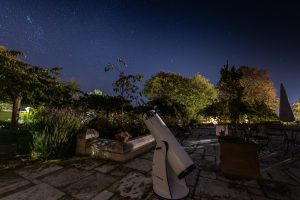
Why Southern Skies are special
Many of the objects in this guide are simply not visible from Europe, North America, or most of Asia. Omega Centauri (a ball of 10 million stars), the Jewel Box cluster, the Tarantula Nebula, and the Magellanic Clouds — companion galaxies to our own Milky Way — are all exclusive to the southern hemisphere. Guests who have spent a lifetime looking at the night sky from the north find the view from New Zealand genuinely revelatory.
Tips for first-time stargazers
Give your eyes time to adjust
Full dark adaptation takes about 20 minutes. Your eyes become dramatically more sensitive as they adjust to the dark — avoid looking at bright phone screens during this time.
Dress warmly
Oamaru nights can be chilly even in summer. Bring an extra layer; you’ll be standing still and looking upward, and the cold arrives quickly once the sun goes down.
Start with your naked eyes
Before looking through the telescope, spend a few minutes simply looking up. The Milky Way, the Southern Cross, and the Magellanic Clouds are all visible to the naked eye from the lodge on clear nights — something many of our guests have never seen before.
Aim for moonless nights
The Moon washes out faint deep-sky objects with its reflected light. The best stargazing occurs in the week around new Moon each month — see the calendar below.
What you see with the eye is different from what you can photograph
Long-exposure photographs reveal vivid colours the human eye cannot perceive at night. Nevertheless, what the telescope reveals is still astonishing.
Southern skies are unique. Many of the objects in this guide — Omega Centauri, the Jewel Box, the Tarantula Nebula, 47 Tucanae — are simply not visible from Europe, North America, or most of Asia. You are seeing things that the vast majority of the world’s population will never see—unless they make their way to the Southern Hemisphere!
When to visit — Moon phases 2026/27
The week centred on each new Moon offers the darkest skies of the month.
| Month | New Moon Date | Highlights |
|---|---|---|
| June 2026 | ~15 June | Milky Way overhead, Scorpius and Sagittarius nebulae--peak month |
| July 2026 | ~14 July | Galactic centre, Wild Duck Cluster, Helix Nebula |
| August 2026 | ~13 August | NGC 6752, Saturn Nebula, Scorpius/Sagittarius |
| September 2026 | ~11 September | Silver Coin Galaxy, Helix Nebula, Magellanic Clouds returning |
| October 2026 | ~11 October | Fornax galaxies, NGC 1365, Orion rising |
| November 2026 | ~9 November | Orion Nebula, Pleiades, Auriga clusters |
| December 2026 | ~9 December | Orion Nebula (best), Tarantula Nebula, Jewel Box |
| January 2027 | ~8 January | Omega Centauri, Jewel Box, Carina Nebula, Magellanic Clouds |
| February 2027 | ~7 February | Scorpius clusters, Lagoon & Trifid Nebulae |
| March 2027 | ~8 March | Vela clusters, Eight-Burst Nebula, Fornax galaxies |
| April 2027 | ~7 April | Omega Centauri (best), Jewel Box, Virgo galaxy cluster |
| May 2027 | ~6 May | Omega Centauri overhead, Sombrero Galaxy, Scorpius rising |
Monthly Stargazing Targets
Use the headings below to jump to the month of your stay. Each section lists ten recommended targets with a brief note on what to expect.
January–High Summer
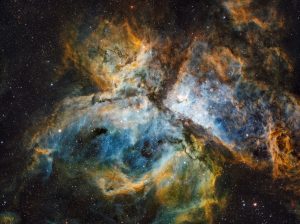
January brings long warm evenings and the southern Milky Way arching overhead from horizon to horizon. The constellations of Centaurus and Crux (the Southern Cross) ride high in the south, offering some of the finest objects in the entire sky — including Omega Centauri, the greatest globular cluster known, and the Jewel Box, one of the most colourful star clusters visible from Earth. The Carina Nebula and the neighbouring star clouds of the southern Milky Way are a constant backdrop for the entire evening. Both Magellanic Clouds — satellite galaxies of our own Milky Way — are well placed in the south-west.
| Object | Description |
|---|---|
| Omega Centauri (NGC 5139) | The finest globular cluster in the sky — 10 million stars in a single ball. Resolves to individual sparkling stars at its edges. |
| Eta Carinae Nebula (NGC 3372) | A vast emission nebula four times the size of the Orion Nebula. Its inner Keyhole Nebula and surrounding star fields make for a spectacular wide-field view. |
| Jewel Box (NGC 4755) | Vivid open cluster beside the Southern Cross — blue-white stars contrasting with a distinctive orange-red supergiant. One of the most colourful clusters in the sky. |
| Centaurus A (NGC 5128) | Peculiar radio galaxy with a dramatic dark dust lane bisecting a giant elliptical — the result of an ancient galaxy merger. The dust lane is clearly visible. |
| Southern Pleiades (IC 2602) | A brilliant naked-eye cluster centred on Theta Carinae — around 60 stars in a wide field. Rivals the northern Pleiades in splendour. |
| Tarantula Nebula (NGC 2070) | The most luminous nebula in the Local Group, residing in the Large Magellanic Cloud. If it were as close as the Orion Nebula it would cast shadows. |
| 47 Tucanae (NGC 104) | Second finest globular in the sky, sitting right next to the Small Magellanic Cloud. Extremely rich and well-resolved, with a blazing compressed core. |
| Alpha Crucis (Acrux) | The brightest star in the Southern Cross — a beautiful double of two blue-white stars, cleanly split at moderate magnification. |
| Wishing Well Cluster (NGC 3532) | John Herschel called this the most brilliant cluster in the heavens. Over 150 stars in a rich oval pattern with chains and loops visible at medium magnification. |
| Coalsack Dark Nebula | A strikingly dark void in the Milky Way beside the Southern Cross — a dense dust cloud blocking the stars behind it. Deeply impressive on dark nights. |
February–Late Summer
February evenings continue to offer the full richness of the southern summer sky. Scorpius rises in the east as the evening progresses, bringing with it some of the finest open clusters and nebulae in the sky. The Large Magellanic Cloud remains high in the south and rewards long, slow sweeps with a wide-field eyepiece — it is an entire galaxy to explore, containing clusters and nebulae of its own. Sagittarius, with its treasure-house of globular clusters and nebulae, climbs higher as the night goes on.
| Object | Description |
|---|---|
| NGC 6752 | The third brightest globular cluster in the sky — frequently overlooked. Beautifully resolved to individual stars with a striking compressed core. |
| Ptolemy's Cluster (M7) | A huge naked-eye open cluster in Scorpius's tail — one of the closest clusters to Earth at only 800 light-years. Over 80 stars, best at very low power. |
| Butterfly Cluster (M6) | Near M7, this cluster has a distinctive butterfly wing pattern at medium power. An orange supergiant provides a lovely colour contrast against the blue-white stars. |
| M4 (NGC 6121) | The nearest globular cluster to Earth at only 5,600 light-years. Beautifully resolved even at low magnification, with a distinctive central bar of stars. |
| Lagoon Nebula (M8) | A large emission nebula bright enough to see naked-eye. Contains a young star cluster and an active star-forming region. Rich in structural detail. |
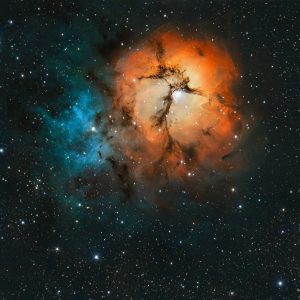
| Trifid Nebula (M20) | Named for three dark dust lanes dividing its glowing face. A rare combination of emission and reflection nebula in one object — the three-lobed division is clearly visible. |
| M22 (NGC 6656) | One of the finest globulars in Sagittarius, better placed from southern latitudes than from the north. Slightly elongated with excellent star resolution. |
| Large Magellanic Cloud | Our nearest large galactic neighbour at 160,000 light-years. Sweep slowly with the widest eyepiece — the density of clusters, nebulae and star clouds can occupy guests for an entire evening. |
| Beta Scorpii (Graffias) | A stunning wide double star at the head of Scorpius — two blue-white stars cleanly separated even at low magnification. One of the best doubles in the southern sky. |
| IC 2602 (revisit) | The star field toward the Carina spiral arm is one of the richest stretches of Milky Way visible from Oamaru. Worth sweeping slowly with the widest eyepiece. |
March–Early Autumn
As autumn approaches, the Milky Way still dominates the southern sky in the early evening, but begins to shift westward as the night progresses. The Vela and Puppis constellations are well-placed, offering a wealth of open clusters and the remarkable Vela Supernova Remnant — the expanding shell of a star that exploded only 10,000 years ago, close enough to Earth to have been visible in broad daylight. The Fornax Galaxy Cluster climbs in the north, offering a window onto a group of galaxies some 65 million light-years away.
| Object | Description |
|---|---|
| Small Magellanic Cloud | Companion satellite galaxy at around 200,000 light-years. Contains bright nebulae and multiple star clusters. The pairing with 47 Tucanae in the same field is unique to southern skies. |
| Eight-Burst Nebula (NGC 3132) | One of the brightest planetary nebulae in the southern sky — a distinct oval ring with a faint central star visible. The southern equivalent of the famous Ring Nebula. |
| IC 2391 | A spectacular naked-eye open cluster around Omicron Velorum — one of the youngest clusters known (around 50 million years), dominated by brilliant blue-white stars. |
| NGC 2516 | Rich open cluster of around 100 stars with a distinctive orange-red giant providing colour contrast. An underrated showpiece that rewards slow sweeping. |
| Running Chicken Nebula (IC 2944) | Large emission nebula containing Thackeray's Globules — dark blobs of gas silhouetted against the glowing background. Look for them as small dark spots near the brightest region. |
| NGC 362 | A superb compact globular beside 47 Tucanae — smaller and denser, with a brilliantly concentrated core. The two clusters make an excellent comparison in the same wide-field view. |
| NGC 1399 & NGC 1404 | Two giant elliptical galaxies at the core of the Fornax Galaxy Cluster, visible in the same eyepiece field. A chance to show that galaxies cluster in groups just as stars do. |
| Fornax A (NGC 1316) | A peculiar lenticular galaxy and one of the brightest radio sources in the sky. Shows a bright core with faint disturbed stellar material — the aftermath of an ancient galaxy merger. |
| Vela Supernova Remnant | Filamentary remnant of a supernova around 10,000 years ago, only 800 light-years away. Individual wisps are visible under dark skies — the closest supernova remnant to Earth. |
| Gamma Velorum | The brightest Wolf-Rayet star in the sky — a massive star blowing itself apart in a fierce stellar wind. An attractive visual double with a dramatic story to tell. |
April–Mid-Autumn
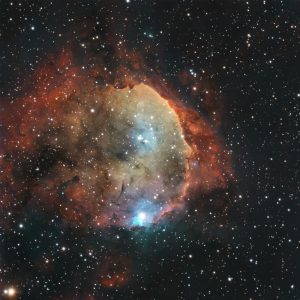
Autumn nights in Oamaru are often particularly clear and stable — some of the best seeing of the year. Centaurus transits almost directly overhead, putting Omega Centauri and Centaurus A at their best. The Southern Cross reaches its highest point of the year in April and May, and the Jewel Box and Coalsack are ideally placed for observation. The Virgo Galaxy Cluster becomes accessible in the north, offering a remarkable vista of dozens of galaxies in a small area of sky — a compelling demonstration of the large-scale structure of the universe.
| Object | Description |
|---|---|
| Pearl Cluster (NGC 3766) | Compact rich cluster of around 100 stars with subtle colour contrast from red and blue giants. Stars arranged in distinctive chains — often overlooked next to the Jewel Box. |
| M46 & M47 | Two rich clusters visible in the same wide field — M47 (brighter, coarser) and M46 (fainter, with 500 members). M46 also contains a foreground planetary nebula as a bonus target. |
| Bug Nebula (NGC 6302) | A spectacular bipolar planetary nebula — even in a 10 inch the elongated butterfly shape is visible. The central star is one of the hottest known but is hidden by a dust disc. |
| NGC 4945 | A bright edge-on spiral galaxy similar in type to the Milky Way. Its long thin profile and notable dark dust lane are easily seen in a telescope. |
| NGC 3293 | Young, bright cluster dominated by blue supergiants with a striking red supergiant for colour contrast. Very compact and visually punchy — one of the finest clusters in Carina. |
| Silver Coin Galaxy (NGC 253) | One of the most detailed galaxies in the entire sky. An edge-on spiral with mottling, dust lanes and star-forming knots all visible in a 10 inch telescope. |
| Omega Centauri (revisit) | April is arguably the best month — you can resolve the outer halo star by star and appreciate just how far the cluster extends. An ever-rewarding object for all skill levels. |
| Mu Crucis | A fine wide double star in the Southern Cross — two hot blue-white stars easily split at low power. A good starter double before moving to tighter pairs. |
| NGC 3199 | A circular wind-blown bubble nebula created by a Wolf-Rayet star. Shows as a faint arc of glowing gas under dark skies. |
| NGC 4976 Group | A bright elliptical galaxy near Omega Centauri with several companion galaxies in the same low-power field — a satisfying cluster of island universes in a single view. |
May–Late Autumn
May sees Centaurus and Crux near the zenith in the early evening, making this arguably the finest month for the great southern showpieces. Omega Centauri, the Jewel Box, and Centaurus A are all at their best. The Virgo Galaxy Cluster is well placed in the north for the whole evening, while Scorpius begins to rise in the east by midnight, hinting at the winter riches to come. The nights are noticeably longer now, giving more time at the eyepiece before dawn.
| Object | Description |
|---|---|
| Sombrero Galaxy (M104) | One of the most photogenic galaxies — an edge-on spiral with a prominent central bulge and a dark equatorial dust lane clearly visible in a 10 inch telescope. |
| Blue Planetary (NGC 3918) | Nicknamed for its vivid blue-green colour — one of the brightest planetary nebulae in the southern sky. Its intense colour is immediately apparent even at low magnification. |
| Alpha Centauri | Our nearest stellar neighbour at 4.37 light-years — two yellow-orange stars currently well separated. The light you are seeing left these stars over four years ago. |
| Virgo Galaxy Cluster | Dozens of galaxies in a small area of sky. Start at Markarian's Chain, then hop between M87, M89, M90 and more. The scale of the universe becomes tangible. |
| Jewel Box (near zenith) | The Jewel Box near its zenith in May — the ideal time. High magnification reveals striking colour contrasts between the blue-white stars and the deep orange of BM Crucis. |
| M68 (NGC 4590) | A loose, well-resolved globular cluster high in the sky from Oamaru — yields individual stars right to its centre, making it excellent for showing the structure of globular clusters. |
| NGC 5286 | A rich compact globular near Centaurus, often ignored next to famous neighbours. Shows granular texture and partial edge resolution in a 10 inch telescope. |
| Omega Nebula (M17) | Rising in the east in May — one of the brightest emission nebulae. Its iconic swan shape is clearly visible, with the associated star cluster evident at its edges. |
| NGC 5460 | A scattered but rich open cluster of around 40 stars. Best at very low power, floating in a sea of Milky Way background stars — a beautiful wide-field scene. |
| Centaurus A (revisit) | Near its overhead zenith in May — the ideal time for detail in the dust lane. Push magnification to reveal structure; the lane absorbs the background elliptical light completely. |
June–Early Winter
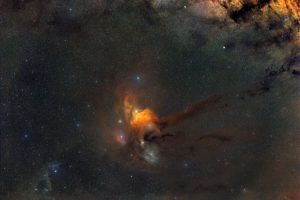
June marks the peak of the southern stargazing year. The Milky Way arches magnificently overhead from south to north, crossing the zenith and offering the richest star fields visible from any location on Earth. The galactic centre in Sagittarius transits h8gh in the north-west, and Scorpius sweeps across the northern sky in a blaze of bright stars, clusters, and nebulae. The long winter nights — darkness from around 6pm to 8am — mean that even visitors who retire early will experience hours of prime observing time. This is the month to let guests simply lie back and absorb the Milky Way with their naked eyes before going to the telescope.
| Object | Description |
|---|---|
| Eta Carinae Nebula (revisit) | Prime time for the Carina region. The Keyhole Nebula's dark silhouette against bright emission is stunning. Push magnification to study the tiny Homunculus around Eta Carinae. |
| M19 (NGC 6273) | The most oblate (flattened) globular in Messier's catalogue — noticeably non-spherical in a 10 inch telescope. Very rich and densely concentrated, close to the galactic centre. |
| M62 (NGC 6266) | A rich compressed globular with an asymmetric core — denser on one side, suggesting close passages near the galactic centre. Sits in a magnificent Milky Way star field. |
| Cat's Paw Nebula (NGC 6334) | A chain of emission nebula lobes resembling a cat's paw print. One of the most active star-forming regions near the Sun. |
| NGC 6231 | A brilliant young cluster near Scorpius's tail, packed with blue supergiant stars. One of the youngest clusters known — only around three million years old. |
| War & Peace Nebula (NGC 6357) | Large emission nebula containing the young star cluster Pismis 24 at its heart. Visible as a glowing patch with distinct internal structure under dark skies. |
| Nu Scorpii | A remarkable quadruple star — a wide pair at low power, each resolving further at high power. Four stars in a single view: a perfect illustration of stellar multiplicity. |
| Eagle Nebula (M16) | Home to the famous Pillars of Creation — an embedded star cluster within glowing gas columns where new stars are forming. A genuine challenge target worth attempting. |
| M6 & M7 (prime) | Scorpius tail clusters at their best in June. Do a naked-eye sweep from Antares first to put the eyepiece views in context. The Milky Way here is extraordinarily rich. |
| NGC 6752 (revisit) | Transiting high in June — ideal for resolution. At high power individual stars resolve right to the compressed core. Note the three concentric zones of density visible under good conditions. |
July–Mid-Winter
Winter continues to deliver spectacular skies. The Milky Way is still high overhead in the early evening, and the globular cluster NGC 6752 in Pavo reaches its best position of the year. Sagittarius and the galactic centre are well placed throughout the night. The Small Magellanic Cloud and 47 Tucanae are high in the south, and the Helix Nebula — the largest planetary nebula in apparent size — rises in the east for late-evening viewing. July also brings the best position of the year for the Wild Duck Cluster in Scutum, one of the richest open clusters known.
| Object | Description |
|---|---|
| Silver Coin Galaxy (NGC 253) | Back in excellent position in the east. Mottled lane structure, star-forming knots and a bright nucleus all visible. One of the most detailed galaxies accessible to amateur telescopes. |
| Helix Nebula (NGC 7293) | The largest planetary nebula in angular size — the Eye of God. In a 10 inch under dark skies the ring structure is clearly visible with brighter inner and fainter outer rings. |
| 47 Tucanae (revisit) | At its best position in July. Long winter nights allow extended sessions — step up magnification progressively to resolve the core, then pull back to appreciate the sweeping outer halo. |
| Wild Duck Cluster (M11) | One of the richest open clusters known — nearly 3,000 stars. A fan-shaped swarm at low power; higher magnification resolves it into hundreds of individual stars. |
| M55 (NGC 6809) | One of the most open globulars in the Messier catalogue — large, diffuse and resolving almost like a rich open cluster. High from Oamaru in July; a wonderful comparison target. |
| Ghost of Jupiter (NGC 3242) | A bright round planetary nebula showing a distinct inner disc and faint outer halo, with the central star visible in a 10 inch telescope. Its blue-green colour is immediately apparent. |
| NGC 300 | A face-on spiral in the Sculptor Group — hints of spiral pattern and star-forming knots visible under good conditions. Part of the same galaxy group as the Silver Coin Galaxy. |
| Scutum Star Cloud | A dense concentration of Milky Way stars visible as a bright naked-eye cloud. Through the widest eyepiece the richness is overwhelming — thousands of resolvable stars. |
| NGC 6723 & NGC 6726/27 | A fine globular cluster sharing the eyepiece field with a colourful blue reflection nebula — one of the most beautiful pairings of completely different object types in the sky. |
| Corona Australis Nebula | A blue reflection nebula surrounding young stars in an active star-forming cloud. Its brightness changes over weeks as the embedded variable star R CrA fluctuates. |
August–Late Winter
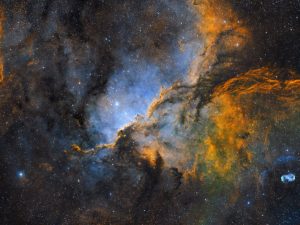
August is the last full month of winter darkness, and the skies remain exceptional. The Milky Way is still high, the Scorpius/Sagittarius region is well placed in the north-west, and the southern constellations of Pavo, Indus, and Microscopium bring some lesser-known but rewarding targets into view. This month also sees the Saturn Nebula in Aquarius at a good altitude — one of the most visually distinctive planetary nebulae, with its Saturn-like extensions visible in a 10″. Oamaru’s winter nights can be chilly, but the atmospheric stability they bring often produces the finest seeing of the year.
| Object | Description |
|---|---|
| NGC 6752 (best month) | August is the ideal month — transiting high with minimal atmospheric distortion. The three-tiered density structure is beautiful. Individual stars resolve right to the compressed core. |
| Saturn Nebula (NGC 7009) | One of the most famous planetary nebulae — at high magnification the Saturn-ring-like extensions are visible in a 10 inch telescope. Vivid blue-green colour. |
| NGC 6067 | A spectacular and largely unknown open cluster in the rich Norma star cloud, with red and yellow supergiants providing colour contrast. The Norma region is one of the densest parts of the Milky Way. |
| NGC 6087 | A beautiful cluster centred on the Cepheid variable star S Normae — watch it brighten and fade over its nine-day cycle across successive nights. |
| Helix Nebula (revisit) | Higher in the sky in August. On a stable night you can see the inner ring's brightening around its rim. The Sun will look similar in around five billion years. |
| M75 (NGC 6864) | One of the most distant and concentrated Messier globulars — around 67,000 light-years away. Appears as a very compact bright ball, clearly distinguishable from open clusters. |
| Beta Tucanae | A wide optical triple in Tucana — three unrelated stars aligned along the line of sight, producing a striking grouping in the eyepiece. All three components white and well matched. |
| NGC 6025 | A bright, attractive open cluster in the tiny southern constellation Triangulum Australe. About 60 stars in a rich Milky Way field — a reliable target between major showpieces. |
| NGC 7331 | A bright inclined spiral galaxy rising in the north-east. At high magnification mottling and hints of dust lanes appear. Four small companion galaxies lie nearby. |
| Wild Duck Cluster (revisit) | Still high in August evenings. A perfect object to alternate between low power for the swarm impression and high power for individual star resolution. |
September–Early Spring
Spring arrives and the character of the sky changes — the winter Milky Way shifts westward, and a new cast of objects rises in the east. The Sculptor constellation climbs in the south-east, bringing the Silver Coin Galaxy (NGC 253), one of the most detailed galaxies accessible to amateur telescopes, to its best position. The Helix Nebula reaches its highest altitude of the year. Andromeda rises in the north — the most distant object visible to the naked eye, at 2.5 million light-years. Both Magellanic Clouds return to good evening positions in the south.
| Object | Description |
|---|---|
| Silver Coin Galaxy — prime (NGC 253) | September is ideal — high in the north around midnight. Multiple dust lanes, star-forming knots and the asymmetric nucleus all visible under good seeing. A genuine showpiece galaxy. |
| NGC 288 | A loose open globular cluster visible in the same wide-field view as the Silver Coin Galaxy — galaxy and globular in one eyepiece, a striking pairing unique to the Sculptor constellation. |
| Helix Nebula — prime (NGC 7293) | September sees the Helix near its highest altitude from Oamaru — the best time to attempt the outer halo and central knot structures. Patient observation across magnifications rewards handsomely. |
| Andromeda Galaxy (M31) | The nearest large galaxy at 2.5 million light-years — the farthest thing visible to the naked eye. Though low in the north from Oamaru, impressive in a wide-field eyepiece with companion galaxy M32 visible nearby. |
| NGC 7793 | A face-on spiral in the Sculptor Group showing granular texture and hints of spiral structure. Part of the same galaxy group as the Silver Coin Galaxy and NGC 300. |
| Saturn Nebula (revisit) | Push to very high power on stable nights and the handle-like extensions that earn it the Saturn name become unmistakable. The central star and multiple shells are also visible under good conditions. |
| NGC 6752 (farewell) | Still well-placed in the south-west in September. Compare in the same session with 47 Tucanae rising in the east — a fascinating contrast in concentration and structure. |
| Caroline's Rose (NGC 7789) | Over 1,000 stars arranged in swirling loops like rose petals — one of the finest open clusters in the sky. Low but accessible from Oamaru. Discovered by Caroline Herschel in 1783. |
| Fomalhaut | The Loneliest Star — far from any other bright stars, and famous for its confirmed debris disc and directly imaged exoplanet. Worth pointing out as a planetary system in formation. |
| NGC 1365 (early view) | One of the finest barred spiral galaxies in the sky, rising in the east. With a 10 inch telescope on a good night, the bar and hints of the two main spiral arms can be glimpsed. |
October–Mid-Spring
October is a month of galaxies. The Fornax Galaxy Cluster reaches its peak, offering multiple bright galaxies within a small area of sky. NGC 1365 — one of the finest barred spiral galaxies in the entire sky — is at its best this month. Orion begins to rise in the late evening, announcing the return of the great nebulae of the summer sky. The nights are warming, and the comfortable temperatures make extended observing sessions more enjoyable for guests new to stargazing.
| Object | Description |
|---|---|
| NGC 1365 (best month) | October is ideal for this magnificent barred spiral. The bar structure is visible in a 10 inch under dark skies. Its nucleus harbours a supermassive black hole — explaining its unusually bright centre. |
| Fornax Galaxy Cluster | Multiple bright galaxies within a few eyepiece fields — Fornax A (a merging system), the giant central elliptical NGC 1399, and its companion NGC 1404. Galaxy-hopping here conveys the large-scale structure of the universe powerfully. |
| 47 Tuc & SMC | Both high and well-placed. Visit 47 Tucanae first, then pull back so the Small Magellanic Cloud fills the field beside it — a globular cluster (16,000 light-years) next to a whole galaxy (200,000 light-years) in one eyepiece. |
| Orion Nebula (early) | Orion rises in late evening in October — the first sight of the season. By midnight it's high enough for a proper look at the Trapezium and the surrounding gas structure. |
| Hyades | The nearest open cluster at just 153 light-years. Sweep the widest eyepiece across the V-shaped face of Taurus to reveal colour variety among the 200 or so member stars. |
| NGC 247 | A highly elongated dwarf spiral in the Sculptor Group. Notable for a mysterious dark void near one end — visible as a surprising absence of brightness in a 10 inch telescope. |
| Cleopatra's Eye (NGC 1535) | A bright blue planetary nebula in Eridanus showing a two-ring appearance at medium power. Its blue colour is one of the most striking of any planetary nebula. |
| NGC 55 | An elongated irregular galaxy — essentially a barred spiral seen nearly edge-on. A long irregular streak with star-forming knots visible along its length. |
| Theta Eridani (Acamar) | A beautiful wide double — two blue-white stars easily split at low magnification. A clean, well-matched pair that often surprises observers expecting a single star. |
| NGC 300 | A face-on spiral in the Sculptor Group, companion to the Silver Coin Galaxy. Larger and more diffuse, showing hints of spiral pattern and star-forming knots under good conditions. |
November–Late Spring
November brings Orion high into the evening sky — and with it the Great Orion Nebula, arguably the most impressive object visible through a telescope anywhere in the sky. The Pleiades ride high in the north-west, the Auriga clusters are well placed, and the entire region around Orion’s sword rewards long, careful sweeping. The nights are shorter now, but the objects on offer are among the most dramatic of the year. Summer is approaching, and the southern constellations of Carina and Centaurus begin to reappear in the south-east by the early hours.
| Object | Description |
|---|---|
| Orion Nebula (M42) | High and well-placed in November evenings. The four Trapezium stars are easy in a 10 inch; dark bay detail and the Huygens Region reward careful study. The finest nebula in the sky for visual observers. |
| Pleiades (M45) | The most famous naked-eye cluster — high from Oamaru in November. At low power the field fills with brilliant blue-white stars and hints of nebulosity around the brightest members. |
| Auriga Clusters (M36, M37, M38) | Three rich open clusters visible in a single wide-field sweep. M37 is the grandest with around 500 stars, M36 the youngest and tightest, M38 shows a cross-shaped pattern. |
| Running Man Nebula (NGC 1977) | A blue reflection nebula just north of M42, visible in the same wide-field view. The blue reflection versus M42's emission provides a beautiful colour contrast. |
| NGC 1981 | The open cluster at the top of Orion's sword. Sweep the full sword region to show NGC 1981, the Trapezium and M42 in context as a single vast star-forming region. |
| Rigel | A brilliant blue-white supergiant with a companion star visible in a 10 inch on good seeing nights. The light left Rigel around 860 years ago. |
| NGC 2516 (revisit) | Back in the east with Carina rising. Over 100 stars in a tight attractive group with a distinctive red giant. A warm-up for the richer Carina targets to come. |
| NGC 1232 | A grand face-on spiral galaxy in Eridanus. The bright core is clearly detected; averted vision hints at the spiral arms. An interacting companion galaxy lies nearby. |
| Cetus Galaxies | Several accessible galaxies for a galaxy-hopping session. NGC 895 is a fine face-on spiral. Try to hop between five or more targets across the constellation in a single evening. |
| Southern Pleiades (IC 2602, revisit) | Carina is back in the evening sky. IC 2602 makes a perfect opening target — a brilliant wide-field object to dark-adapt with before moving to fainter deep-sky targets. |
December–Early Summer
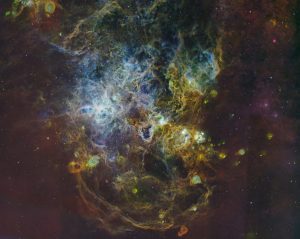
December sees the southern sky return to its summer configuration. Orion and the Orion Nebula are at their highest from Oamaru, nearly overhead, giving the clearest and most detailed views of the year. Carina and Centaurus rise in the south-east during the evening, and by midnight the Jewel Box and the Eta Carinae Nebula are well placed again. The Large Magellanic Cloud and the Tarantula Nebula within it return to prominence — a fitting way to close the year. Despite the shorter nights of summer, the quality of the objects on offer in December makes every hour at the telescope worthwhile.
| Object | Description |
|---|---|
| Orion Nebula — prime (M42) | At its highest from Oamaru in December — nearly overhead, giving the clearest possible views. The Trapezium, Fish Mouth bay, Huygens Region and outlying gas filaments are all at their finest. |
| Tarantula Nebula — peak (NGC 2070) | The Large Magellanic Cloud is high in December and the Tarantula is at its finest. Sweep outward from the central star cluster through the sweeping spider-leg arms of glowing gas. |
| Beehive Cluster (M44) | Rising in the north-east — over 1,000 stars in a wide field. Scan through the cluster; there are multiple double stars embedded within it to find as a bonus. |
| Jewel Box (returning) | Crux rises in the south-east in December evenings. The Jewel Box's return signals summer — a seasonal marker worth sharing with guests before letting the cluster's colours speak for themselves. |
| NGC 2362 | A compact cluster dominated by the supergiant Tau Canis Majoris — one of the most luminous stars known — surrounded by around 60 fainter companions. The contrast between the blazing central star and the swarm is beautiful. |
| NGC 2360 | A rich open cluster of around 80 stars in Canis Major. The richness of the Milky Way in this region provides a sea of faint background stars to complement the cluster. |
| Rosette Nebula (NGC 2237) | A vast circular emission nebula surrounding open cluster NGC 2244. Very low surface brightness — best with a filter and wide-field eyepiece. The central star cluster alone is a fine target. |
| Sigma Orionis | A spectacular multiple star just south of Alnitak in Orion's belt. In a 10 inch at least five components are visible in a tight grouping — one of the finest multiple star systems for amateur telescopes. |
| Pleiades (revisit) | High in the north-west in December evenings — at their finest from Oamaru. On exceptional nights the nebulosity around the brightest members is detectable with the widest eyepiece. |
| Omega Centauri (returning) | Just rising in the south-east by late December — the first hint of the next season's greatest showpiece. Even at low altitude its size and brightness are immediately apparent. The southern year has turned. |
Download our illustrated guide to the Oamaru night sky here.